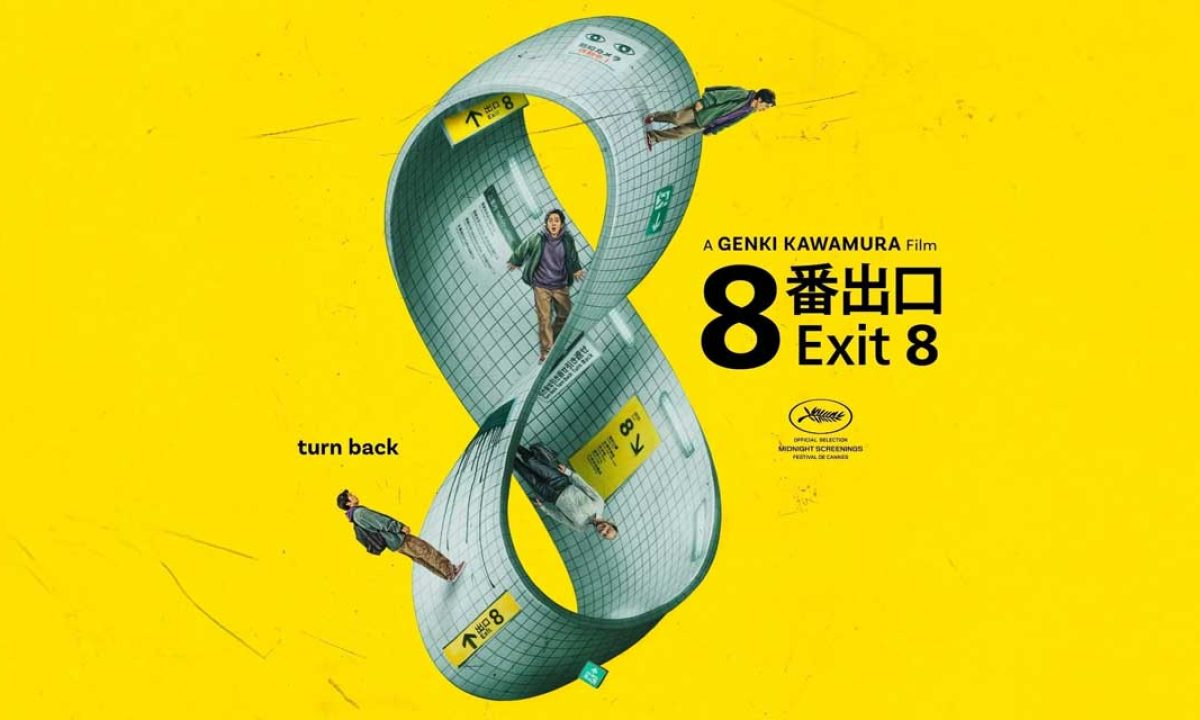
Trapped in a meaningless cycle of work, commuting, and isolation, a young worker in a busy Japanese city notices a man on his subway car brutally berating a young mother for her baby’s crying. Disturbed by the display, but paralyzed by fear and inertia, he turns away and blocks out the sound with his earbuds. After stepping off the train, he winds his way through a labyrinth of platforms and concourses and finds himself in an endlessly looping series of identical corridors, marked by a sign reading:

Thus begins the liminal-space horror of Genki Kawamura’s Exit 8, an adaptation of the Kotake Create video game of the same name. Our protagonist, who we only know as The Lost Man, must pay close attention to the little details that make up his sterile purgatory – faces on advertisement posters, a pile of trash heaped next to a bank of subway lockers, the presence or absence of doors and lights and access panels, and the Walking Man, who moves obliviously along the same path every time he enters the hallway – in order to navigate his way back to the real world he has left behind. Each time through the passageway he gets a chance to move one exit forward, from zero to eight, as long as he’s been perceptive enough to notice whether or not anything anomalous appeared. A mistake in either direction sends him back to square one (that is, Exit 0).
Exit 8 recreates the environment of the video game that preceded it meticulously. The set and lighting design work together to communicate the feeling of postmodern industrial alienation which was first popularized by internet users sharing photos of empty hallways and abandoned stores and offices, and star Kazunari Ninomiya sells the claustrophobic panic that his Lost Man feels more and more acutely as the story progresses.
Where Exit 8 stands apart from many of its game-adaptation peers is in the way that it uses not only the setting and characters but also the core gameplay mechanics of its inspiration to communicate its story and themes. The video game does not feature a narrative, just a creepy environmental puzzle for the player to solve, but the endless loop of the subway tunnels and the soullessness of the environment in which the player spends all of their time prove metaphorically fertile for telling a story about the kind of powerless limbo that many modern workers feel locked into.

The narrative makes it clear that the Lost Man was lost long before this story began. He is cut off from contact with other human beings, including the woman who may be carrying his child, he’s isolated from the natural world by his work and long commute and from his immediate surroundings by the pacifying glow of his smartphone, and he’s losing touch with his very humanity as is evidenced by his inability to take action when he sees a fellow human in need. The path that he must take to free himself involves looking and listening to everything around him, seeing and noticing and choosing to take an active role in his life and his progress, without which he will remain stuck in the same meaningless loop until what remained of his soul has faded completely (we get a window into this possible path when we learn more of the Walking Man’s story).
The ending of the movie even has a “new game plus” feeling to it, when it becomes clear that after “escaping” his ordeal, he must continue to act with the courage and humanity that he learned underground or his life will return to the meaningless cycles that defined it before, and his humanity will be truly lost.
If all Exit 8 had going for it were its surface-level accomplishments in production and lighting design and immersive cinematography, it’d still be among the stronger video game-to-movie adaptations around. But in using the structure of its inspiration to tell a very human story with a message that resonates strongly in the world where we find ourselves today, it sets itself apart as something special.


Leave a Reply