“AI cannot hunger or thirst. It can only regurgitate.“
So claims an insightful piece by Eleanor Russell, which illuminated to me a lot of the problems I have with the idea of “art” being generated by an unthinking and unfeeling machine, not to mention whether there could be anything worthwhile to experience in such a product. Says Russell:
The concept of AI actors reveals a malevolent paranoia. Rather than risk being confronted by a work of art that throws into question your way of living, you can have a lithe and large-eyed AI gyrate on the floor in exactly the way you have prompted her to. You will never be tricked into believing something you have not decided in advance you want to believe. AI is compelling to tech billionaires and their minions because it offers the fantasy of total control. They have found a way to conquer their phobia of humanity, which is by turning it into a malleable simulacrum. Of course, it looks like total shit and has, thus far, mainly been used to facilitate taking selfies with various action movie characters. The imagination of the average AI booster is so impoverished that they do not even dream of going on a high seas adventure with Captain Jack Sparrow, or assisting a heist with Ethan Hunt from the Mission: Impossible movies, or doing blow with Leonard diCaprio as whatever character they wish. The most they dream of is a selfie, a gesture to feeling included in a creative community they do not have the intellectual or creative capacity to ever really belong to. And so their greatest dreams look like total ass, because they lack the theory of mind to imagine anything but ass. It can’t create anything new, and therefore what these people are trying to call “AI performance” isn’t that, it’s a failed and abject imitation.
It’s hard to come up with a precise definition for “art.” To me, a non-negotiable part of the definition is that art is the creative expression of a human being’s unique perspective on the world they observe. When I approach a piece of art, I want to be challenged by it. Often, but not exclusively, in a way that causes discomfort or reshapes how I see the world.
There’s plenty of room, of course, for art that provides comfort and relief. But even artistic comfort food poses to its audience an inherent challenge, because it’s coming from another human being who is different from you. Their perspectives will at times contrast with yours. Their ideas will sometimes be alien to you. The way they look at the world is different from how you look at the world, and the friction of your perspective encountering another human’s creates both growth and pleasure. Conversely, encountering the product of a prompt designed to scrape together bits of data that it has been “trained” on in order to please the reader/viewer is solipsistic, sycophantic, and emptily masturbatory, providing neither the edification that comes with experiencing another’s creativity nor the pleasure that comes from an intellectual or emotional interaction with another being.
Creativity is work. To create anything demands that you open yourself up to the friction between your ideas, your outlines, your thumbnail sketches, and the exterior reality of what you can make with your hands and fingers and voice. Expressing (pushing out, like juice from a lime) your thoughts and feelings requires energy and strength and commitment. It’s hard! Many people who fancy themselves creatives recoil from the discomfort inherent in this process. Some feel that the ability of a large language model to whip up a simulacrum of human creativity based on an idea they wave at it is liberatory, freeing them from the work that would otherwise be required in order to be the artist they think they are. But an artist, a writer, isn’t something you can “be” in a static capacity. You are only an artist to the extent that you do art. You are a writer only to the extent that you write. The idea that you can be a creative who has freed yourself of the work of creation fundamentally misunderstands the meaning and the value of creativity as a human process.
Russell continues:
Figuring out what and who to believe is harder than it has ever been. If we are to find it, we have to do it together. Typing “make a pop song sung by a beautiful woman” into a prompt window, to the AI booster, is equivalent to writing “Call Me Maybe” by Carly Rae Jepsen. “Call Me Maybe” is a miracle of God. The reason these two things are equivalent to them is because they do not actually like pop music, because AI guys don’t actually like anything. They are anti-life. If art is to survive at all, we cannot cede an inch of ground to these fascist idiots. It’s a shame that the figure of the sociopath in popular culture is genius-coded, because the sociopaths who are attempting to structure our reality–art included–have rocks for brains. We have to remember this at all times.
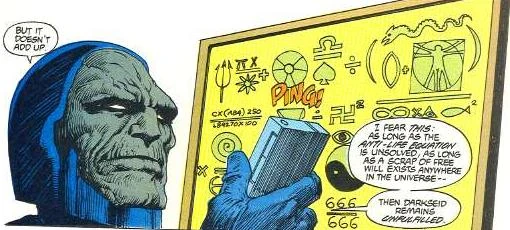
Her usage of “anti-life” recalls Darkseid, Jack Kirby’s personification of crushing fascist evil in his insane and wonderful New Gods comic book series. Darkseid is obsessed with solving the “anti-life equation”, a formula which will allow him to eradicate not breath, heartbeats, or the self-replication of DNA, but free will and thought. This is what Kirby recognized as vital to life: individual thought, feeling, and self-determination. The most evil being he could imagine devotes himself to snuffing out the capacity to create and express ourselves based on the ineffable essence of our unique souls.
Let’s not do it for him.
 Soup Is Good Food
Leave a comment